Wiki · Free and open
How nuclear power works
Three levels: the concepts you need to understand any reactor, an animated guide for each type, and an entry for each specific design, from the VVER to the ACR-300.
Reactors mapped
443
Wiki entries
92
Animated guides
11
Start here
Three levels, about 20 minutes each
The concepts
Fission, moderation, criticality, the fuel cycle. The dozen ideas every reactor design builds on.
32 entries · start with fission
02The types
Nine animated, scroll-driven guides, one per reactor family, from PWR to research reactors.
11 guides · PWR is the busiest
03The designs
Every commercial design in detail: Westinghouse loops, VVER, CANDU, AP1000, and more.
43 entries · linked from each guide
Reactor types
11 animated guides · 43 designs
Fission
 BWRBoiling waterWater boils inside the vessel and the steam goes straight to the turbine.≈ 60 operating
  PHWR · CANDUPressurized heavy waterNatural uranium moderated by heavy water in pressure tubes; on-power refueling.≈ 47 operating
  GCR / AGRGas-cooledGraphite moderator and CO₂ coolant at high temperature. A British design.≈ 9 operating
 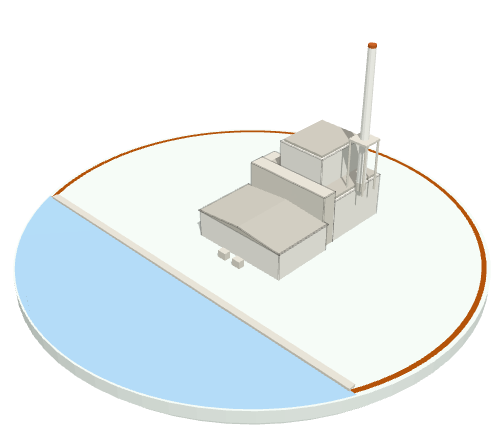 LWGR / RBMKGraphite and light waterPressure tubes with boiling water and a graphite moderator. A Soviet design.≈ 8 operating
 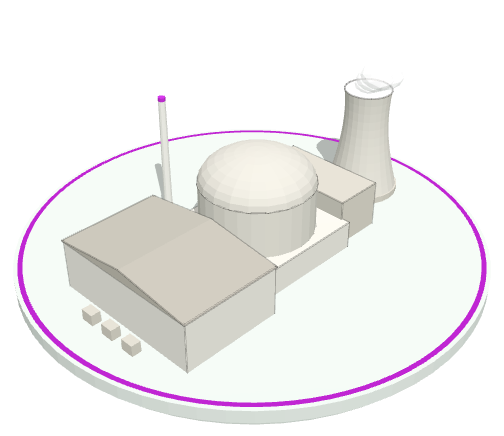 FBRFast breederNo moderator, sodium-cooled; produces more fissile material than it consumes.≈ 2 operating
 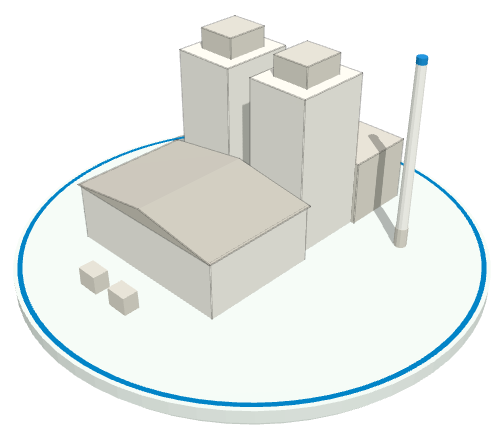 HTGRHigh-temperature gasTRISO particle fuel and helium above 700 °C. The HTR-PM.≈ 1 operating
 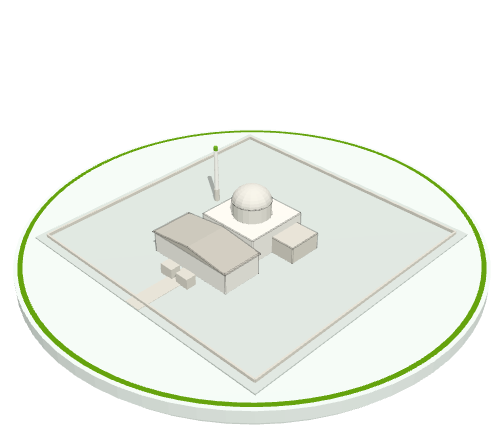 SMRSmall modular reactorFactory-built modules under 300 MWe with passive safety. Families and status in 2026.≈ 3 under construction
  RRResearch reactorsNeutrons, not electricity: open pools from 0 to 100 MW for radioisotopes, materials testing, neutron beams and training.≈ 292 operating
Fusion
 StellaratorStellaratorConfines the plasma with twisted coils instead of an induced current, which lets it sustain it in steady state.≈ 6 operating
 - ICFInertial confinementCompresses a fuel capsule with lasers within a span of nanoseconds, instead of holding the plasma for seconds.≈ 3 operating
- Other pathsAlternative conceptsMagnetic mirrors, field-reversed configurations, Z-pinches, spheromaks and magnetized target fusion.≈ 14 operating
- FusionWhat fusion isTwo light nuclei join into a heavier one and release even more energy per gram than fission.
Fundamental concepts
Reactor physics
- Concept
What nuclear fission is
A heavy nucleus splits in two, releasing energy and neutrons, and those neutrons split other nuclei. Everything else follows from that.
- Concept
Chain reaction, moderator and control
For a neutron to have a good chance of fissioning a nucleus it has to be slowed down. And to govern power, the surplus ones have to be absorbed.
- History
The first reactor
Chicago, December 2, 1942: a pile of graphite and uranium under a stadium grandstand goes critical. Twelve years later, Obninsk connects the first reactor to a grid.
- Concept
Thermal power and electrical power
MWt is the heat the core produces; MWe is the electricity that reaches the grid. Two thirds are lost between one and the other, and that is physics, not bad engineering.
- Concept
Capacity factor and the economics of a reactor
A reactor costs a lot to build and almost nothing to run. That is why it runs at full load 80 to 90% of the year, and why its cost per kilowatt-hour depends on interest rates and construction time more than on uranium.
- Concept
Rated power, uprates and derates
A reactor's power is not one fixed number: there is a gross power at the generator terminals, a net power that reaches the grid and a reference power the regulator authorises. When that figure goes up it is called an uprate; when a unit runs below it for a while, a derate.
- Concept
Fuel burnup
Burnup measures how much energy was extracted from each tonne of uranium before it was taken out of the reactor. It went from about 40 to more than 60 GWd/t in light-water reactors, and that changed how much fuel is bought and how much waste is left.
- Concept
Bringing a reactor into service
First criticality, grid connection and commercial operation are three distinct dates in a new reactor's life, weeks or months apart. The IAEA's PRIS records all three; Reactor Atlas uses commercial operation to set the in-service year.
- Concept
How a nuclear power plant works
From fission in the core to steam, from steam to the turbine and the grid, and what happens to the two-thirds of the heat that goes unused: the full circuit of a nuclear power plant, explained start to finish.
- Concept
Molten salt reactor (MSR)
In an MSR the coolant is a molten salt, and in several designs the fuel is dissolved in that same salt: no fuel elements, near-atmospheric pressure, and fission products that can be removed while the reactor runs. From Oak Ridge's MSRE in the 1960s to China's TMSR-LF1 and the US MCRE today.
Safety
- Concept
Safety barriers and defense in depth
Four physical barriers between the fission products and the environment, and several layers of systems that assume the previous one can fail. No single one has to be perfect.
- Concept
Decay heat and emergency cooling
A shut-down reactor keeps producing heat: 6.5% of its power at the instant of shutdown, 1.5% an hour later. Cooling it without electricity is the problem that explains Fukushima and defines the new designs.
- Concept
Cooling towers: the white plume is water vapour
The white plume rising from a cooling tower is not smoke and carries no radioactivity: it is water vapour condensing as it mixes with cooler air, the same thing that makes your breath visible in winter.
- Concept
The INES scale
Eight levels, 0 to 7, to say in one figure how serious a nuclear event was. Each level is about ten times more severe than the last: Three Mile Island was a 5; Chernobyl and Fukushima, 7.
- Concept
ALARA and dose limits
A dose limit is a ceiling you may not cross. ALARA is the duty to stay as far below that ceiling as you reasonably can. They are two different things, and most public argument about radiation runs them together.
- Concept
Is nuclear energy safe?
Health effects per unit of electricity generated and evidence on Chernobyl, Fukushima and Three Mile Island.
Fuel and waste
- Concept
Fuel and enrichment
Natural uranium is 0.7% U-235. Depending on the reactor, it is used as is or concentrated up to 5%, and in the new designs up to 20%.
- Concept
The nuclear fuel cycle
From the mine to the pellet and from the pellet to the repository: mining, conversion, enrichment in SWU, fabrication, burnup in GWd/t, spent fuel, reprocessing and MOX.
- Concept
Radioactive waste
3% of the volume holds 95% of the radioactivity. That 3% decays a thousandfold in about 40 years, is stored in dry casks and Onkalo in Finland is still awaiting an operating licence before emplacement starts.
- Concept
Decommissioning a nuclear power plant
Shutting the reactor down is the start, not the end. What follows is a sixty-year deadline, a fund worth hundreds of millions, and spent fuel that almost never leaves the site: which is why all three Yankee plants finished decommissioning and are still licensed nuclear sites.
- Concept
Is nuclear energy renewable?
It depends on which definition is used, and the definition is conventional, not physical. Uranium is a finite mineral pulled out of a mine, so most classification frameworks keep it out of the renewables category, even though it shares the low-carbon category with them.
- Concept
Is nuclear energy clean?
"Clean" bundles two separate questions. In life-cycle emissions, nuclear's median is 12 gCO₂eq/kWh, in the same range as wind and solar. In waste, the question is volume and final disposal, not existence.
History and places
- History
Oklo, the natural nuclear reactor in Gabon
At Oklo, Gabon, uranium fissioned on its own about 2 billion years ago: between fifteen and seventeen zones pulsing on and off for hundreds of thousands of years, now mined out except for Bangombé.
- History
Marine nuclear propulsion
The sea was the light-water reactor's first destination and is still its most common one: over 160 military vessels and 14,000 reactor-years of operation. On the civilian side, four merchant ships were built and none is still in service.
- Concept
What is a microreactor
Between 1 and 20 megawatts thermal, assembled in a factory, shipped whole and running for years without refuelling. It is not a small SMR: it is a piece of equipment that gets delivered. The US Army already ran eight reactors that size between 1957 and 1977.
Sources and regulation
- Concept
The world's nuclear databases
Almost all public data on the world's reactors passes through a handful of registries: three run by the IAEA — PRIS, the RRDB and INFCIS — and one independent one, Global Energy Monitor. Each covers a different slice.
- Concept
REMIT and unavailability notices
In Europe, a reactor tripping is not just technical news: it is information that can move the price of electricity, and the law requires it to be published. REMIT is that rule, and it sets how each notice is read.
- Concept
How to read a capacity projection
Every capacity projection rests on an anchor, and the anchor decides how it will be wrong: anchored to poured concrete it fails on timing, anchored to a policy target it fails on magnitude, and a projection that mixes the two inherits both failures.
- Concept
Restarting a shut-down reactor
Switching a closed reactor back on is rarely a physics problem. In the United States the obstacle is a piece of paper: the permanent-cessation certification strips the licence of its authority to operate, and undoing that took almost two years in the first case that managed it.
- Concept
Life extension: what decides whether a reactor runs past 40 years
Life extension requires evidence that a plant can continue to meet its safety requirements. The NRC explains that the initial 40-year term of US licences had an economic origin; France assesses continued operation through periodic reviews every ten years.
- Concept
Design certification and international standardization
A reactor approved in the United States is not approved in France or Korea: every national regulator keeps the last word over its own territory. When five regulators compared the same EPR, they found it was not the same.
- Concept
Advantages and disadvantages of nuclear energy
Electricity output, land use, investment, construction and waste management: nuclear energy’s benefits and limitations, with sources and dates.
The accidents
Three Mile Island, Chernobyl and Fukushima, step by step
- 1979 · INES 5
Three Mile Island
A relief valve stuck open, an indicator that showed the command instead of the position, and operators who throttled emergency injection: 45% of the core melted inside a containment that held.
- 1986 · INES 7
Chernobyl
A reactor with a positive void coefficient, a low-power test, and an emergency shutdown that, because of the graphite tips of its own control rods, began by inserting reactivity instead of removing it.
- 2011 · INES 7
Fukushima Daiichi
The earthquake shut it down and the design worked. Fifty minutes later a fifteen-metre wave arrived over a five-seventy defence, the diesels flooded and three cores were left with no way to cool them.
Designs
PWRPressurized water
BWRBoiling water
PHWR · CANDUPressurized heavy water
LWGR / RBMKGraphite and light water
FBRFast breeder
HTGRHigh-temperature gas
SMRSmall modular reactor
RRResearch reactors
The fuel cycle
Front end
- Fuel cycle
Mining and in-situ leach
Most of the world's uranium is no longer dug out with a shovel: it is dissolved underground and pumped to the surface. Kazakhstan, almost all of it by that method, produces four of every ten tonnes on the planet.
- Fuel cycle
Conversion to uranium hexafluoride
Yellowcake has to become a gas before isotopes can be separated. Only five plants in the world convert it into UF₆, and in 2022 the sole US plant produced not a single tonne.
- Fuel cycle
Enrichment and the SWU
The SWU measures the effort of separating isotopes, not the uranium itself. Russia controls nearly half of world enrichment capacity, and Pilcaniyeu makes Argentina one of thirteen countries that master the technology.
- Fuel cycle
Fuel assembly fabrication
From a ceramic powder to a half-tonne assembly. Each reactor type builds its fuel differently, and in Ezeiza CONUAR has been, since 2012, the only fabricator of CANDU components outside Canada.
- Fuel cycle
HALEU and TRISO
The fuel that advanced reactors and SMRs need: uranium at 5-20% and ceramic particles that contain themselves. Until 2023, nearly all the world's commercial HALEU was Russian.
Back end and services
- Fuel cycle
Spent fuel, reprocessing and dry storage
On the way out of the core, spent fuel is still hot and still useful. A third of the world's spent fuel is reprocessed at La Hague, Rokkasho still hasn't started after nearly thirty years of delays, and Atucha II is building its own dry store, ASECG II.
- Fuel cycle
Heavy water
Heavy water is what lets a CANDU or Atucha run on natural uranium. It is made with a process that uses a great deal of energy, and the plant that produced it in Argentina, in Arroyito, is starting up again.