Thermal output100 MWt
Electric only · Integral PWR
CAREM-25: Argentina's modular reactor
The CAREM-25 is CNEA's modular (SMR) reactor: an integral PWR of 100 MWt under construction at Lima, Buenos Aires, with steam generators inside the vessel.
Integral PWR prototype rated at 100 MWt, 25 MWe net and 32 MWe gross. CNEA reports that the project started in 2014 is under review; its regulatory authorization for construction and commissioning dates from 2013.
- Stated output
- 100 MWt · 25 MWe net · 32 MWe gross · per unit
- Maturity
- Stage not stated
- Developer
- Comisión Nacional de Energía Atómica (CNEA)
- Origin
- Argentina
01
Energy and applications
Published magnitudes; this is not an engineering diagram.
Electrical output25 MWe net · 32 MWe gross
Stated uses
02
Three different states
Maturity, licensing and deployment are not equivalent.
Maturity
Stage not statedHow far the published engineering has progressed.
Licensing and review
1 regulatory readingWhat a regulator decided, where and on what date.
Linked deployment
1 geolocated unitWhich projects or units are linked to the design.
03
Linked deployment
| Plant | Unit | Country | Dataset status |
|---|---|---|---|
| Atucha | CAREM | Argentina | construction |
04
Licensing and review
What a regulator decided, where and on what date.
| Jurisdiction | Reading | Method | Date |
|---|---|---|---|
| Argentina | Site construction authorized | Non-routine practice authorization for construction and commissioning under ARN Resolution 351/2013 | 2013-09-12 |
05
Technical sources
- IAEA ARIS · CAREM 2020IAEA · 2020
- Argentina · Nuclear energy sector report 2025Government · 2025
- ARN Resolution 351/2013 · CAREM-25 authorizationRegulator · 2013-09-12
- 01
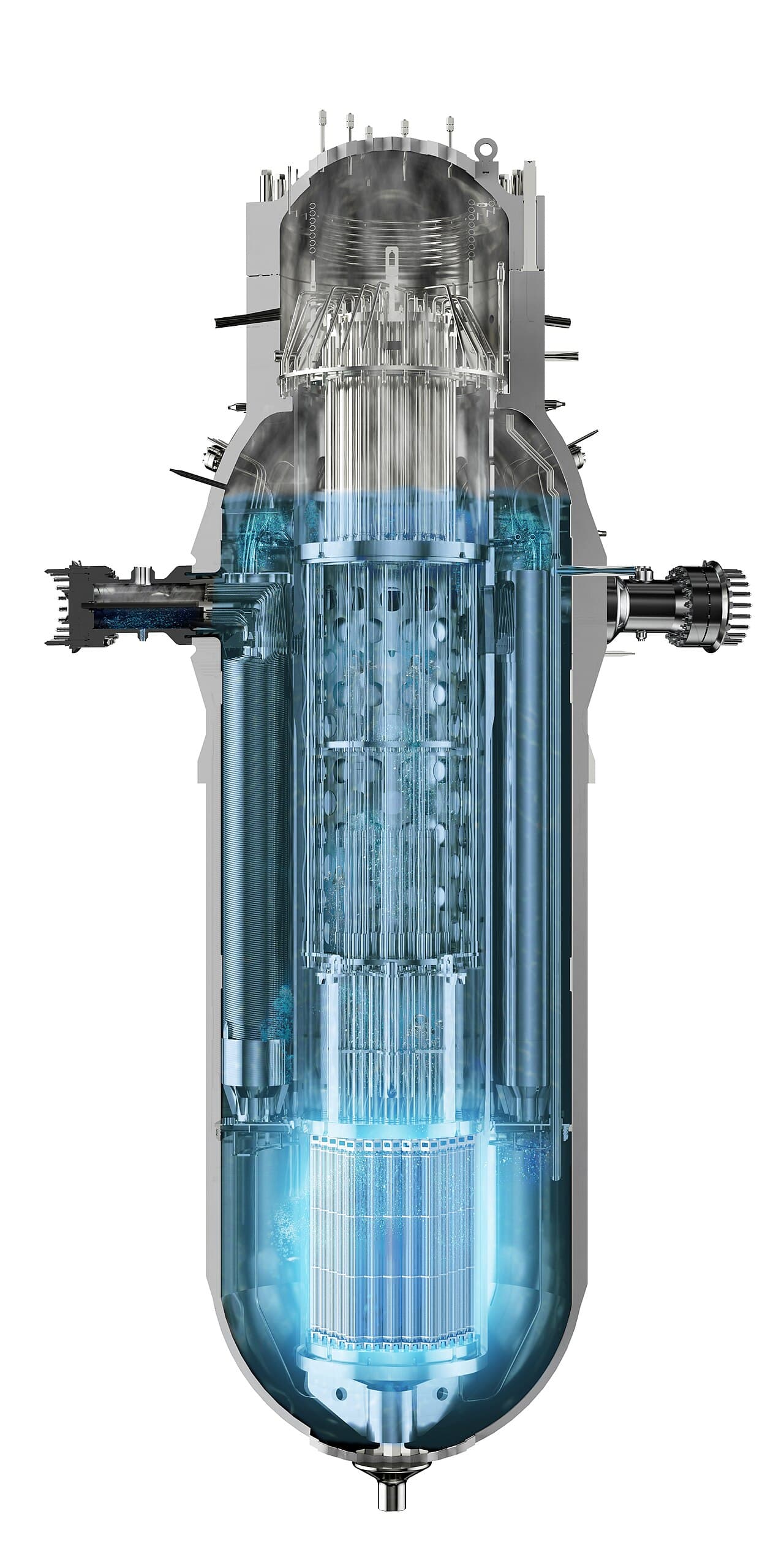
CAREM, Central Argentina de Elementos Modulares, is the power reactor of the Comisión Nacional de Energía Atómica. The CAREM-25 prototype is an integral PWR of 100 MWt and on the order of 30 MWe gross, about 25 MWe net: the entire high-energy primary system, the core, the steam generators, the coolant and the steam dome, sits inside a single forged-steel vessel with stainless cladding, 11 m tall and 3.2 m in diameter, with walls 13 to 20 cm thick. With internals and steam generators it weighs 267 metric tons.
With no primary piping, the largest vessel penetration is 38 mm: the large-break loss-of-coolant accident, which sizes much of the safety case of a conventional PWR, drops off the list of possible events. Twelve helical once-through steam generators, each with 52 tubes 26 m long in six layers, fill the annular space above the core and deliver dry steam at 4.7 MPa with 30 °C of superheat.
- 02
There are no coolant pumps. Water enters the core at 284 °C, leaves at 326 °C and rises through a 4.6 m riser; at the top it exits the riser through lateral windows, flows down the annulus where the steam generators sit, gives up its heat and re-enters the core from below. The density difference between the hot and cold columns drives 410 kg/s. The flow rate adjusts itself to the power: if the core generates more heat, more water circulates.
Nor is there a separate pressurizer: the vessel's steam dome sets the pressure at 12.25 MPa by liquid-vapor equilibrium. The core outlet temperature is the saturation temperature at that pressure, and a fraction of steam formed by flashing in the riser makes up for what condenses on the cold structures of the dome. The heaters and sprays of a classic PWR disappear. It is also the most debated point of the design: an internal CNEA report circulated in 2026 questioned the degree of experimental validation of this natural-convection cooling and opened a controversy within the sector.
- 03
The core has 61 fuel assemblies of hexagonal cross section and 1.4 m active length, each with 108 rods 9 mm in diameter, 18 guide tubes and one instrumentation tube. The fuel is UO₂ enriched to between 1.8 and 3.1%, with gadolinium oxide as burnable poison in specific rods. No dissolved boron is used in the coolant during normal operation: reactivity is controlled with rods alone, and the prototype has a reference cycle of 14 months with replacement of half the core and a burnup of 24 GWd/t.
The 25 control rod drive mechanisms are hydraulic and sit entirely inside the vessel: a flow of pressurized water holds each silver-indium-cadmium rod cluster in position, and flow pulses move it step by step. Nine are fast-shutdown rods and sixteen are regulating rods. If power to the pump that generates that flow is cut, the rods drop into the core by gravity in about two seconds. CNEA has tested the mechanisms in a high-pressure, high-temperature loop since 2011, and with them the possibility of a rod being ejected from the vessel disappears.
- 04
The safety systems need neither electrical power nor operator action to start. Two independent shutdown systems: the first drops the rods by gravity; the second injects borated water from two 1 m³ tanks, also by gravity, in under 35 minutes, and either one alone is enough to shut the reactor down. Two relief valves, each with 100% of the required capacity, protect the vessel against overpressure.
Decay heat is removed by two passive condensers with horizontal U-tubes submerged in pools inside the containment: they condense steam from the dome and return the water to the vessel by natural circulation. With just one of them the core stays covered and cool for 36 hours after a total loss of power, which the design treats as a design-basis event. For loss-of-coolant events, two tanks at 2.8 MPa inject water when the pressure drops below 1.5 MPa. The containment is cylindrical, of the pressure-suppression type, with 1.2 m reinforced-concrete walls, a steel liner, a design pressure of 0.5 MPa and a 0.25 g design earthquake; it provides for hydrogen control and in-vessel retention of the corium.
- 05
The secondary side is conventional: feedwater at 200 °C enters through small nozzles, rises inside the helical tubes in counterflow to the primary and leaves as dry steam at 4.7 MPa toward a turbine, a generator and a condenser. The steam leaves superheated, the steam generators are designed to withstand primary pressure with the secondary side depressurized, and the entire secondary side up to the isolation valves withstands primary pressure if a tube ruptures.
The prototype is being built on the Atucha site, at Lima, Zárate district, Buenos Aires province. The reactor building covers 18,500 m², of which about 14,000 m² belong to the nuclear module. Around 70% of the qualified supplies, components and services come from Argentine companies: the vessel was contracted in December 2013 for 298 million pesos of the time, and the engineering, the steam generators and the control rod drives were developed with local industry. That supply chain is today the base on which INVAP promotes the ACR-300.
- 06
The concept was presented in 1984 at an IAEA conference on small reactors in Lima, Peru, and it is one of the first integral SMRs in the world. In 2009 CNEA submitted the preliminary safety report to the Nuclear Regulatory Authority; in September 2013 the ARN authorized construction and in February 2014 first concrete was poured. Start-up was planned for 2017, then 2020, 2022 and finally late 2027. The civil contractor, Techint, stopped work in November 2019 over payment delays and design changes; work resumed in 2020 and 2021, and in October 2023 Nucleoeléctrica signed a technical assistance agreement with CNEA.
In May 2024 CNEA's new leadership put the design through a 60-day critical design review, focused on the internals not yet manufactured. In September of that year the three contractors laid off 153 workers, 470 over the year, and the site came to a halt; in early 2025 CNEA formally suspended construction to concentrate the budget on engineering. Physical progress stood at 63% at the end of 2024, with civil works far advanced. During 2025 the preservation team shrank from 30 to 7 people, and in April 2026 CNEA announced it would downgrade the project's management. At least US$750 million has been invested. There is no restart date; the commercial version, of 100 to 120 MWe, never left the drawing board.
Conceptual CAREM-25 geometry. Primary water rises through the core and riser and returns through the generator annulus; secondary water flows inside the tubes. CNEA / IAEA · 2024
Comparison
CAREM-25, NuScale and ACP100
Three integral light-water PWRs. CAREM-25 is the smallest and the only one with neither a pressurizer nor heaters; NuScale also circulates by natural convection; China's ACP100 uses pumps and is the first one running.
| CAREM-25 (CNEA) | NuScale VOYGR | Linglong One (ACP100) | |
|---|---|---|---|
| Power | 100 MWt · ≈ 30 MWe | 250 MWt · 77 MWe per module | 385 MWt · 125 MWe |
| Primary circulation | Natural, no pumps | Natural, no pumps | Forced, pumps on the vessel |
| Pressurization | Steam dome, no heaters | Pressurizer inside the vessel | External, vertical pressurizer |
| Steam generators | 12 helical once-through, in the vessel | Helical, in the vessel | 16 once-through, in the vessel |
| Primary pressure | 12.25 MPa | 12.8 MPa | 15 MPa |
| Core temperatures | 284 → 326 °C | 258 → 314 °C | 286.5 → 319.5 °C |
| Fuel | 61 hexagonal FAs · 1.8 to 3.1% · 14 months | 37 FAs 17 × 17 · < 4.95% · 24 months | 57 FAs 17 × 17 · < 4.95% · 24 months |
| Reactivity control | Rods only, 25 internal hydraulic drives; no boron | Rods and dissolved boron | Rods, gadolinium and dissolved boron |
| Containment | Pressure suppression, 1.2 m concrete | Steel vessel submerged in the reactor pool | Passively air-cooled |
| Status 2026 | Construction suspended, 63% physical progress | Certified design, no construction | Starting up in Hainan |
Reference
Quick facts
| Designer | CNEA · Argentina · 1984 concept |
|---|---|
| Power | 100 MWt · ≈ 30 MWe gross (32 MWe in CNEA fact sheets) · 25 MWe net |
| Primary pressure | 12.25 MPa · self-pressurized in the dome |
| Core temperatures | 284 °C inlet · 326 °C outlet |
| Circulation | natural · 410 kg/s · 4.6 m riser |
| Vessel | 11 m × 3.2 m ⌀ · forged steel · 267 t with internals and SGs |
| Steam generators | 12 helical once-through · 52 tubes × 26 m · steam at 4.7 MPa |
| Fuel | 61 hexagonal FAs · 108 rods of 9 mm · UO₂ 1.8 to 3.1% · 14 months |
| Control rods | 25 hydraulic drives inside the vessel · Ag-In-Cd |
| Safety | passive · 36 h without power · two boron tanks · emergency condensers |
| Containment | pressure suppression · 1.2 m concrete · 0.5 MPa · 0.25 g |
| Site | Atucha site · Lima, Zárate, Buenos Aires |
| Construction | ARN license Sep. 2013 · first concrete Feb. 2014 · halted Sep. 2024 · suspended 2025 |
| Progress | 63% physical at end of 2024 · ≥ US$750 M invested |
Further reading
Recommended reading
- CNEA · Proyecto CAREM
- IAEA ARIS · Advances in Small Modular Reactor Technology Developments, 2018 (CAREM sheet, p. 7)
- Marcel, Delmastro, Schlamp and Calzetta · CAREM-25: a safe innovative small nuclear power plant, Nuclear España, 2017
- World Nuclear News · Argentina's CAREM SMR project to have Critical Design Review (May 2024)
- EconoJournal · El CAREM, en pausa: la CNEA desjerarquizará el proyecto (Apr. 2026, Spanish)
Sources
Sources consulted
The design parameters come from the CAREM sheet in the IAEA SMR catalogue (2018 edition, written by CNEA) and from the technical article by the project's engineers in Nuclear España (2017); where the two sources differ, for example on the vessel diameter, 3.2 to 3.5 m, or the gross electrical power, 27 to 32 MWe, the IAEA sheet is used. Construction milestones and the 2024 to 2026 status are taken from the specialized press.
- IAEA ARIS · Advances in Small Modular Reactor Technology Developments, 2018 edition, CAREM sheet (CNEA, Argentina)https://aris.iaea.org/Publications/SMR-Book_2018.pdf
- C. Marcel, D. Delmastro, M. Schlamp, O. Calzetta · CAREM-25: a safe innovative small nuclear power plant, Nuclear España, January 2017 (CONICET repository)https://ri.conicet.gov.ar/handle/11336/66802
- CNEA · Proyecto CAREMhttps://www.argentina.gob.ar/cnea/carem
- World Nuclear News · Argentinean projects to resume after hiatus (Apr. 2020)https://world-nuclear-news.org/Articles/Argentinean-projects-to-resume-after-hiatus
- World Nuclear News · CNEA and Nucleoeléctrica sign CAREM SMR agreement (Oct. 2023)https://www.world-nuclear-news.org/Articles/Argentina-s-SMR-CNEA-and-Nucleoelectrica-sign-agre
- World Nuclear News · Argentina's CAREM SMR project to have Critical Design Review (May 2024)https://www.world-nuclear-news.org/articles/critical-design-review-for-argentina-s-carem-small
- Nuclear Engineering International · Argentina's CAREM-25 SMR faces setbacks (Sep. 2024)https://www.neimagazine.com/news/argentinas-carem-25-smr-faces-setbacks/
- Buenos Aires Herald · Construction of first Argentine-made nuclear power reactor halted amid layoffs (Sep. 2024)https://buenosairesherald.com/business/construction-of-first-argentine-made-nuclear-reactor-halted-amid-layoffs
- EconoJournal · El CAREM, en pausa: la CNEA desjerarquizará el proyecto y preocupa su precario estado de conservación (Apr. 2026, Spanish)https://econojournal.com.ar/2026/04/el-carem-en-pausa-la-cnea-desjerarquizara-el-proyecto-y-preocupa-su-precario-estado-de-conservacion/
- EconoJournal · Polémica por un reporte de la CNEA que pone en duda una característica clave del reactor CAREM (Jun. 2026, Spanish)https://econojournal.com.ar/2026/06/polemica-por-un-reporte-de-la-cnea-que-pone-en-duda-una-caracteristica-clave-del-reactor-carem/
- World Nuclear Association · Nuclear Power in Argentinahttps://world-nuclear.org/information-library/country-profiles/countries-a-f/argentina
- Global Energy Monitor · CAREM nuclear power plant (PRIS data: 29 MWe gross, 25 MWe net)https://www.gem.wiki/CAREM_nuclear_power_plant
The real fleet
The unit of this type in the atlas
None operating, in 1 country, 1 under construction.